

Moonstone: The Complete Guide to Meaning, Benefits and How to Use It
Discover the meaning of Moonstone, its connection to the Moon and how to choose and care for this beautiful crystal.
Written by Moon Sutras
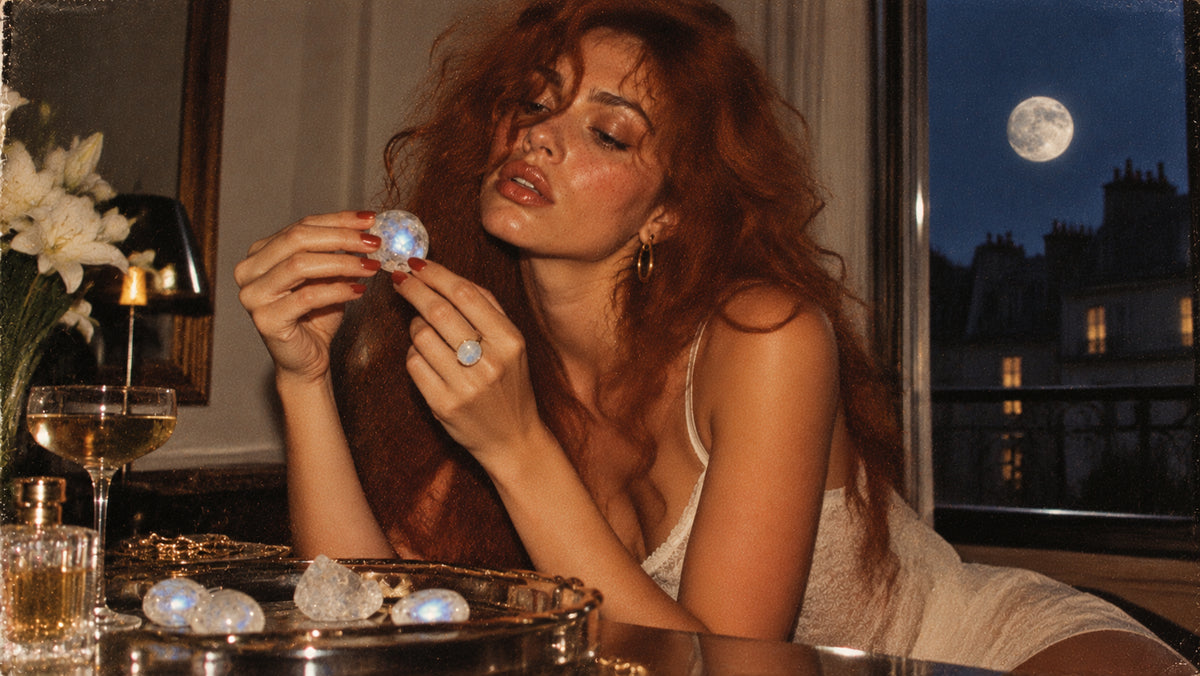
Moonstone is an unusual gemstone. Its appearance can seem almost ordinary until it catches the light. Then a soft glow moves beneath the surface, revealing something that wasn't immediately visible.
Perhaps that's part of its appeal.
In contemporary crystal traditions, Moonstone is associated with intuition, emotional balance and new beginnings. It's often chosen by people experiencing change, although change doesn't always mean wanting something different.
You can be excited about a new beginning and still miss what you're leaving behind. You might know a decision is right for you without feeling entirely comfortable making it.
Moonstone has become a symbol of these contradictions, particularly through its association with the Moon and its changing phases.
What Is Moonstone?
Moonstone belongs to the feldspar family of minerals. Its defining characteristic is adularescence, an optical effect that creates a soft, shifting glow beneath the stone's surface.
This happens when light interacts with microscopic mineral structures inside the gemstone.
As you turn Moonstone, the light appears to move. Some stones display a silvery-white sheen, while others reveal flashes of blue.
Moonstone occurs in several colours, including white, peach, grey and green. Sri Lanka, India and Madagascar are among its important sources.
Unlike gemstones valued primarily for intense colour, Moonstone is particularly admired for the quality of its moving light.
What Does Moonstone Symbolise?
Moonstone is commonly associated with intuition, emotional balance and the changing nature of life.
Its connection with the Moon has appeared in gemstone folklore across different cultures. In contemporary crystal practices, that symbolism often extends to personal change and the ability to adapt.
But adapting doesn't always mean welcoming change.
Someone may spend months preparing to leave a relationship, only to feel unexpectedly unsettled once it's over. Another might achieve the independence they've wanted for years and discover that freedom comes with decisions they can no longer leave to someone else.
Moonstone can represent the willingness to experience these conflicting feelings without expecting every decision to bring immediate certainty.
Moonstone in Vedic Astrology
In Vedic astrology, the Moon is known as Chandra and is associated with Manas, the mind.
The Moon's position in a birth chart is traditionally examined when interpreting emotional responses, habits and the way someone experiences the world.
A person may appear confident and self-sufficient while privately needing considerable reassurance. Someone else might be sensitive to criticism but remarkably composed when others need support.
Vedic astrologers consider the Moon's sign, house, Nakshatra and planetary influences when interpreting these differences.
In classical Jyotish gemstone traditions, Pearl is the principal gemstone associated with the Moon. Moonstone is also used as a lunar gemstone in some contemporary and alternative practices, but the two should not be presented as interchangeable classical prescriptions.
For a fuller explanation of Chandra's significance, read Why the Moon Matters in Vedic Astrology.
What Are the Benefits of Moonstone?
Moonstone is commonly chosen for three symbolic associations.
Emotional Balance
Someone can feel things intensely without always knowing what to do with those feelings.
You might recognise that a situation is temporary yet struggle to stop thinking about it. Or remain outwardly calm while privately replaying a conversation.
Moonstone is often used as a reminder to acknowledge emotions without allowing every passing feeling to determine the next decision.
Intuition
Moonstone is also associated with intuition in modern crystal practices.
But intuition isn't the same as assuming every strong feeling is correct.
You might sense that something isn't right, only to discover that your concern came from an earlier experience rather than the present situation.
Moonstone can symbolise the importance of paying attention to instinct while remaining willing to question it.
New Beginnings
New beginnings can be uncomfortable even when they're welcome.
Starting a business, moving home or entering a relationship may bring opportunities alongside unfamiliar responsibilities.
Moonstone is often chosen to mark these transitions. Its significance comes from the intention attached to it, not from a proven ability to influence events.
What Are the Different Types of Moonstone?
Moonstone appears in several varieties and colours.
White Moonstone is valued for its pale appearance and silvery or blue glow.
Peach Moonstone has a warmer colour, ranging from soft peach to orange-brown.
Grey Moonstone has a darker body colour that can make its sheen particularly striking.
Rainbow Moonstone is a jewellery trade name commonly used for a variety of labradorite displaying blue or multicoloured flashes. Despite the name, it isn't the same mineral variety as traditional orthoclase Moonstone.
When choosing between them, consider the quality of the sheen, the colour and how the stone looks in different lighting.
How to Wear and Use Moonstone
There is no single correct way to wear Moonstone.
A necklace may be suitable if you prefer a delicate piece that sits close to the body. Earrings are another option, particularly if you want to enjoy the stone's changing light.
A bracelet can become a reminder of a personal intention throughout the day, although it may be exposed to more knocks during ordinary activities.
You can also incorporate Moonstone into meditation.
Some people hold a stone while reflecting on a decision or use it to mark the beginning of a regular practice.
If you associate Moonstone with the lunar cycle, you might choose to set an intention at the New Moon or reflect on recent experiences around the Full Moon.
These are personal and contemporary ritual practices, not requirements for owning or wearing the gemstone.
How to Cleanse and Care for Moonstone
Spiritual Cleansing
Some people place Moonstone in moonlight, use incense or incorporate it into meditation.
If you choose to leave it in moonlight, keep it somewhere dry and secure rather than exposing jewellery to unsuitable outdoor conditions.
Is Moonstone Suitable for Everyday Wear?
Yes, with appropriate care.
Moonstone jewellery can be worn regularly, although its durability depends on the type of jewellery and how it is used.
Earrings and necklaces generally experience fewer accidental knocks than rings and bracelets.
Remove Moonstone jewellery before activities that may expose it to hard impacts, abrasion or chemicals.
A little care will help preserve the appearance that makes the gemstone so distinctive.
Why Choose Moonstone?
Some people choose Moonstone for its traditional associations. Others simply love the way the light moves beneath its surface.
Both are good reasons.
You might buy it to mark a new beginning, only to find that years later it reminds you of the person you were before everything changed.
The meaning you attach to a stone doesn't have to remain the same.
And Moonstone doesn't need to promise emotional transformation to be worth owning. Its natural beauty and personal significance are enough.
Explore the Moonstone collection to find a piece that appeals to you.
(collection: moonstone)


