

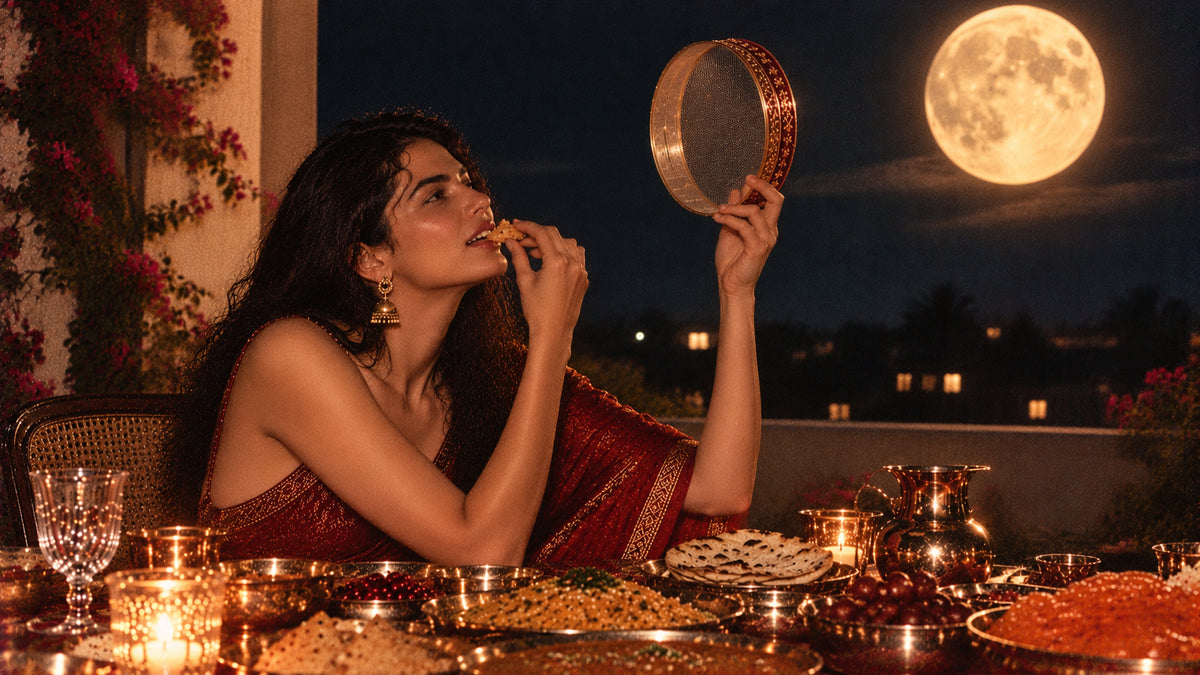
Once a year, millions of Hindu women observe Karwa Chauth, a festival in which the Moon determines when a day-long fast can finally end. From before sunrise until Moonrise, many go without food or water, following a tradition associated with marriage, devotion and the hope of a long life for their husbands.
But Karwa Chauth is more than a fast. It is a ritual shaped by the lunar calendar, family traditions and the changing meaning of marriage itself. Some women observe it because their mothers and grandmothers did. Others find genuine emotional or spiritual significance in the practice. For some, it is a celebration of love. For others, it raises questions about why devotion has historically been expressed through women's sacrifice.
And at the centre of it all is the Moon.
What Is Karwa Chauth?
Karwa Chauth is a Hindu festival traditionally observed by married women who fast and pray for the health and longevity of their husbands. It is especially associated with northern India, although Hindu families observe it in different ways across India and around the world.
The word Karwa refers to an earthen pot used in the rituals, while Chauth means fourth, referring to the fourth lunar day on which the festival falls.
Traditionally, the fast begins before sunrise and ends after the Moon has risen. In many households, women gather for prayers, listen to the Karwa Chauth story, exchange ritual items and prepare to break their fast with their husbands.
Not everyone observes it in the same way. Some unmarried women also fast, sometimes with the hope of finding a future husband. Some couples now observe the fast together. Others choose not to participate at all.
These differences are part of how an old tradition continues to exist within modern relationships.
Why Does the Date of Karwa Chauth Change Every Year?
Karwa Chauth does not fall on the same date each year because it follows the Hindu lunar calendar rather than the Gregorian calendar.
It is observed on Krishna Paksha Chaturthi, the fourth lunar day of the waning Moon in the month of Kartik according to the North Indian calendar.
In 2026, Karwa Chauth falls on Thursday 29 October.
The date is determined by the Moon's position in its monthly cycle. Unlike a fixed calendar date, the festival moves from year to year because the lunar and solar calendars do not align exactly.
This relationship with the Moon is fundamental to Karwa Chauth. The lunar calendar determines when the festival takes place, while the Moon's appearance in the evening determines when many observers can break their fast.
Why Do Women Wait for the Moon on Karwa Chauth?
The Moon is not simply a beautiful backdrop to Karwa Chauth. It plays a central role in the ritual itself.
In Hindu tradition, the Moon, known as Chandra, is associated with the mind, emotions, nourishment and the rhythms of life. Its changing phases have long been used to determine religious observances, fasting days and festivals.
On Karwa Chauth, women traditionally offer water to the Moon, known as arghya, before ending their fast.
In many families, the Moon is viewed through a sieve, followed by a look at the husband through the same sieve. The husband may then offer the first sip of water or food.
The ritual varies between households, but the symbolism connects the celestial body that governs the festival with the relationship being honoured.
There is also something distinctive about a tradition that depends on an event no one can hurry. Dinner may be prepared, prayers completed and the family gathered, but the fast traditionally continues until Moonrise.
For women who have observed Karwa Chauth for years, that moment can carry memories of childhood, marriage and family. For someone observing it for the first time, it may feel quite different.
(ritual-box)
What Happens During the Karwa Chauth Fast?
The day often begins before sunrise with sargi, a pre-dawn meal traditionally prepared or given by a mother-in-law. It may include fruit, nuts, sweets and other foods intended to sustain the woman through the day.
After sunrise, those observing a strict nirjala fast abstain from both food and water until the Moon rises.
Women may dress in traditional clothing, apply mehndi and wear jewellery associated with marriage. In some communities, they gather in the afternoon or evening for a puja and listen to the Karwa Chauth vrat katha, the traditional fasting story.
Once the Moon has risen, the evening rituals take place and the fast is broken.
Not all women follow every element of the tradition. Practices vary according to family customs, regional traditions, personal beliefs and health considerations.
Karwa Chauth 2026: What Time Will the Moon Rise?
Because Karwa Chauth is observed in different countries, there is no single Moonrise time that applies to everyone.
The Moon rises at different times depending on your location. Someone observing Karwa Chauth in London will not see the Moon rise at the same time as someone in Delhi, Mumbai or New York.
If you are observing Karwa Chauth, you can check the Moonrise time for your own city using the Moon Sutras Moon Calendar.
Select your location and date to see local Moonrise and Moonset times, alongside Sunrise and Sunset. The calendar supports worldwide city searches and automatically adjusts for local time zones.
Bear in mind that the calculated Moonrise time is an astronomical prediction. Weather, buildings and the local horizon can affect when the Moon becomes visible.
Karwa Chauth, Marriage and the Meaning of Devotion
Karwa Chauth is often described as a festival of marital love, but that description does not capture every woman's experience.
For some, fasting is a deeply personal expression of devotion. The rituals connect them to their mothers, grandmothers and the marriages they grew up observing. What might appear restrictive from the outside can feel meaningful to someone who has chosen to continue it.
For others, the tradition is more complicated. The expectation that a woman should fast for her husband's longevity raises questions about reciprocity, particularly when the same sacrifice has not historically been expected of men.
Some couples respond by fasting together. Others reinterpret the day as an occasion to celebrate their relationship without observing a strict fast.
And some women continue participating because they enjoy the sense of community, even if their beliefs about marriage differ from those of previous generations.
The significance of Karwa Chauth is not identical for everyone who observes it. Its survival across generations has involved both continuity and change.
The Moon in Vedic Astrology
In Vedic astrology, the Moon is associated with the mind, emotional responses, habits and the ways we seek security.
Its movement through the 12 zodiac signs and 27 Nakshatras forms an important part of traditional astrological timing.
The Moon's role in Karwa Chauth is primarily religious and calendrical rather than a prediction about an individual marriage. The festival is determined by a lunar tithi, while its concluding ritual is connected to the local Moonrise.
These are related but distinct ways of understanding the Moon.
If you are curious about the Moon in your own birth chart, you can use the free Moon Sign Calculator to discover your Vedic Moon Sign, Nakshatra and Pada.
A Festival That Still Follows the Moon
Karwa Chauth has changed in the way it is celebrated, particularly among younger generations and Hindu communities living outside India.
Some couples share the fast. Some families adapt the rituals. Others preserve the traditions almost exactly as they remember them.
What remains is the relationship between the festival and the lunar cycle. Its date changes each year, and its most recognisable evening ritual still depends on the Moon rising above the horizon.
For those observing Karwa Chauth, the Moon Sutras Moon Calendar provides Moonrise and Moonset times for cities around the world.


